Context & problem
This coursework application manages employer, job and applicant records using C# and ASP.NET Core MVC. Each job belongs to an employer; the local demonstration follows that relationship through the application's real forms and saved lists.
Recorded application screens
From employer to saved jobs
Manage employers and their job listings through real MVC forms and saved records.
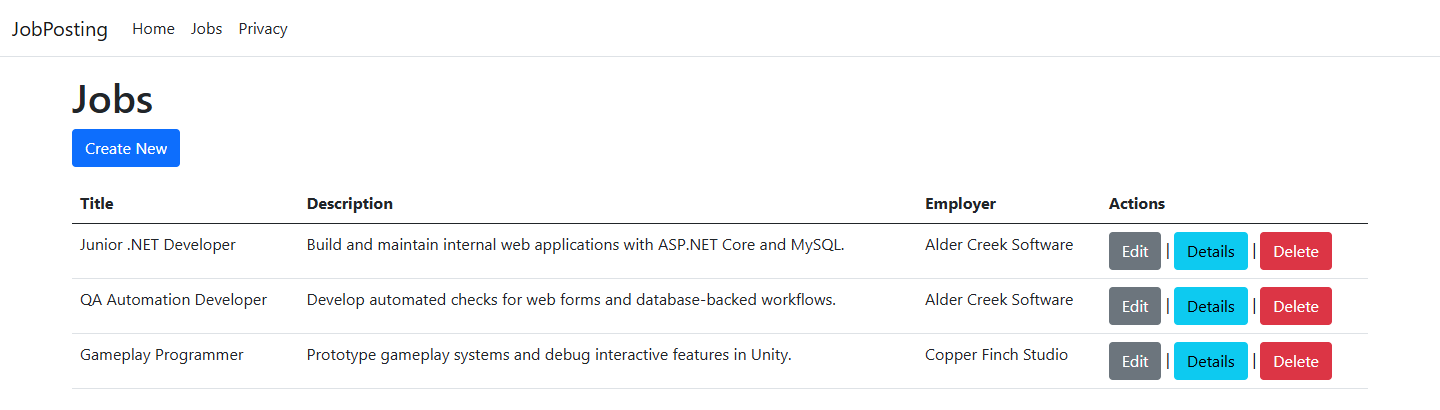
↔ Scroll wide screenshots horizontally to inspect every column. Focus the image region and use arrow keys, or swipe.
Application walkthrough. Explore the employer and job-management workflow through screenshots of this working ASP.NET Core MVC project.
Local demonstration with fictional data
Step 1 of 3
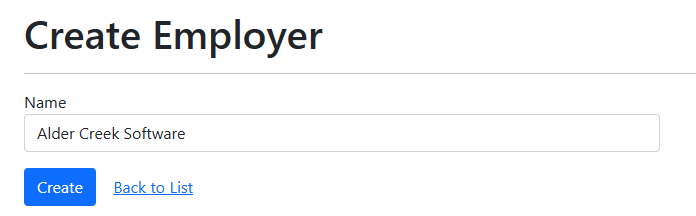
Enter a fictional employer
This is the filled form before submission, not confirmation that the employer has been saved.
What to notice: Alder Creek Software is a fictional employer. The saved Employers view provides the separate result.
Contribution & scope
- Worked with MVC controllers and Razor views for employer, job, and applicant CRUD workflows.
- Used Entity Framework Core and a MySQL provider for relational persistence.
- Modeled employer-to-job and applicant-to-job relationships.
How it fits together
- ASP.NET Core MVC separates routing and controller logic from models and Razor views.
- Controllers use dependency-injected database context access and asynchronous Entity Framework queries.
- An employer can have multiple jobs. The job form selects an existing employer, and the saved Jobs list displays its name.
- An applicant/job join entity models a many-to-many relationship in the schema; the demonstrated interface does not implement an Apply-to-Job workflow.
What I learned
- MVC separates rendering, request handling, and application data concerns.
- Relational constraints and validation help keep linked records consistent.
- Database credentials belong in local environment configuration, not committed application settings.
Outcome & boundaries
- Context: Coursework, not a production hiring platform
- Stack: C#, .NET 8, ASP.NET Core MVC, Entity Framework Core, MySQL